
Cyclistic Ride Pattern Analysis
Understanding casual riders vs annual members
Business Scenario
Cyclistic is a bike-share company operating in Chicago. The director of marketing believes the company’s long-term growth depends on increasing annual memberships. We have been tasked with comparing riding patterns between casual riders and annual members in order to identify opportunities to increase membership.
Questions, Data & Transformation
When we begin an analysis, we start with a business objective, the question/s that need to be answered. In this case, the core question is: what are the differences between casual riders and member riders, and how can we convert more casual riders into members?
While reviewing the dataset, I discovered that several fields contained missing values, inconsistent entries, or data quality errors within many columns. Before meaningful analysis could begin, these issues needed to be identified and corrected to ensure accurate comparisons and trustworthy insights.
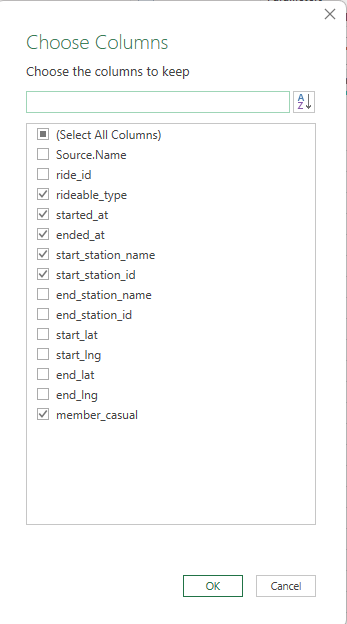
During the data cleaning process, I identified the fields that I wanted to target for analysis and removed any columns I did not need. This allows me to de-clutter the dataset and focus my attention on identifying on any missing metrics to support KPIs. I then created time-based calculated columns to support trend analysis, seasonality comparisons, and differences in behavior between casual and member riders.
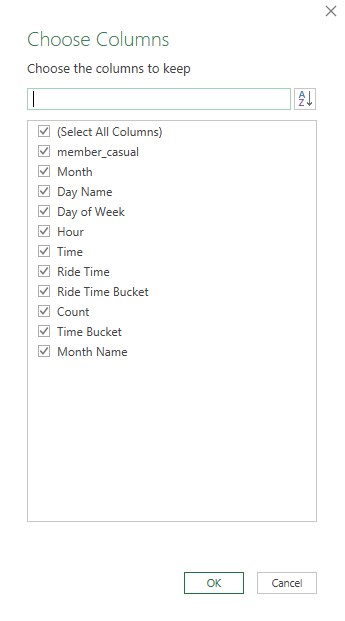
As shown below, once all calculated columns were created, only a single original column was required to continue the analysis. This highlights an important principle in analytics: meaningful insights are rarely found in the raw data alone.
The real value lies in what can be created from the data, through unbiased transformation, thoughtful modeling, and purposeful feature engineering, allowing hidden patterns and behavioral trends to emerge.
Key Visuals & Insights
Ride Time by Month
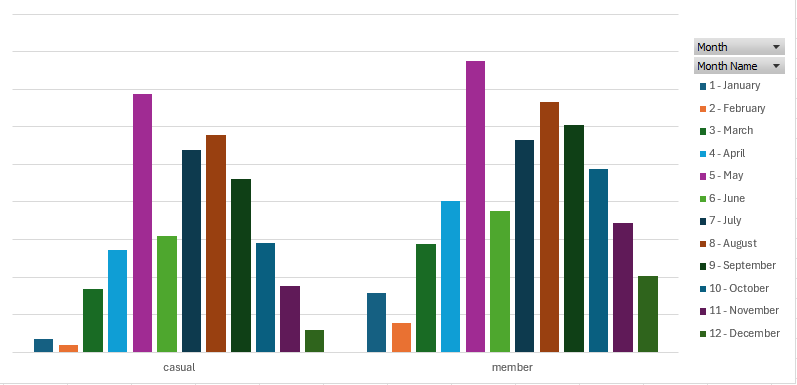
I first wanted to examine the ride volume between casual and membership riders over the course of a year. From the visual below, we can see that the overall distribution remains relatively consistent throughout the year. As a preliminary look and our first dive into the data, there are limited insights at this stage beyond the following observations:
- Ride volume remains consistent across both rider groups throughout the year.
- A large increase in ride volume begins in May, which can be attributed to improved weather conditions and riders returning after the long winter months.
The most significant insight gleaned from this visualization is that membership riders maintain higher ride volumes during December, January, and February. This finding sparked further interest and forms the basis for the remainder of the analysis: why are members riding more frequently during the winter months?
Ride Time by Hour
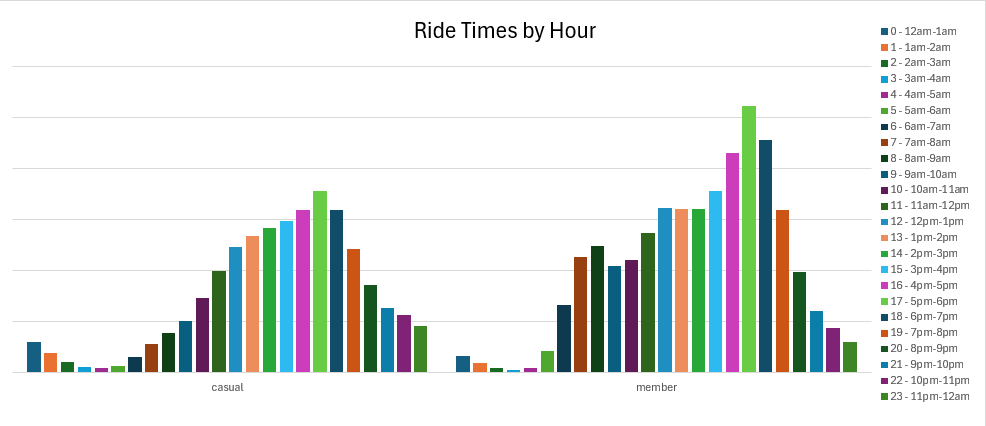
Next, I analyzed ride times throughout the day to determine whether additional patterns existed beyond those observed in the initial monthly analysis.
The following chart reveals clear time-of-day behavioral differences between casual and member riders. Member usage increases sharply during traditional commuting hours, with strong peaks occurring between 7–9am and again between 4–6pm. This pattern suggests that members primarily use the bike-share system as a reliable mode of transportation. In contrast, casual riders show limited early-morning activity and a gradual increase throughout the late morning and afternoon, indicating more leisure-oriented usage.
Both rider types reach their highest activity levels during the late afternoon; however, member ridership peaks more sharply and declines more quickly after commute hours. Casual riders maintain steadier usage into the evening, reflecting recreational travel patterns. These trends highlight that time-of-day behavior is a strong differentiator between rider types and presents a clear opportunity to target frequent afternoon casual riders for membership conversion.
Ride Time by Day
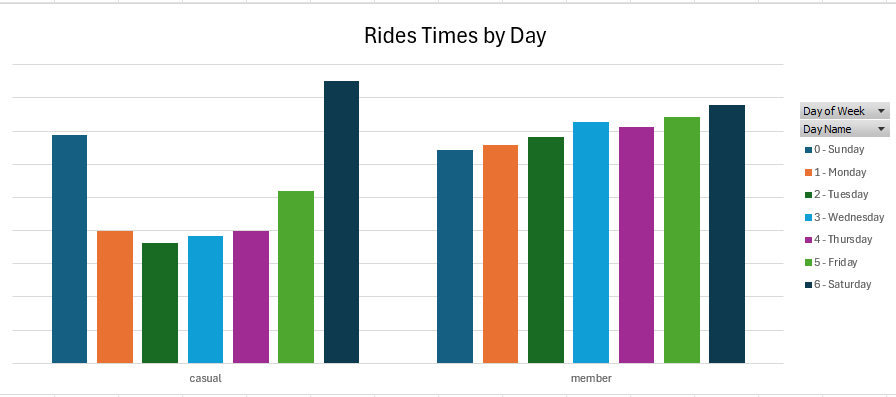
The daily ride distribution chart, featured below, further reinforces the conclusion that member usage is primarily commute-driven. Member ride volumes remain consistently high from Monday through Friday, with only a modest increase on weekends. This stable weekday pattern aligns closely with traditional work schedules, indicating routine transportation behavior rather than recreational use.
In contrast, casual ridership displays a markedly different pattern. Casual rides are significantly lower during the workweek and increase sharply on Saturday and Sunday, with the highest volume occurring on Saturday. This weekend-heavy distribution suggests leisure and tourism-based usage. The clear differences between weekday member activity and weekend casual activity strongly supports the theory that members predominantly use the bike-share system for commuting purposes.
Summary Insight & Conclusions
These findings highlight a significant opportunity to convert high-frequency weekend riders into long-term customers. Rather than promoting a single membership model centered on weekday commuting, a more flexible membership structure could better align with how casual riders actually use the service.
A recommended approach is the introduction of a tiered membership system. This could include a traditional annual membership designed for daily commuters, alongside lower-cost weekend-focused tiers targeted specifically at casual riders. A weekend membership package—offering unlimited or discounted rides from Friday through Sunday would appeal to leisure riders while lowering the barrier to entry for full membership adoption.
By aligning membership options with observed rider behavior, the organization can increase conversion rates, improve rider retention, and capture additional revenue from users who currently rely on single-ride pricing. This data-driven tiered strategy ensures that membership offerings reflect real-world usage patterns rather than a one-size-fits-all model.